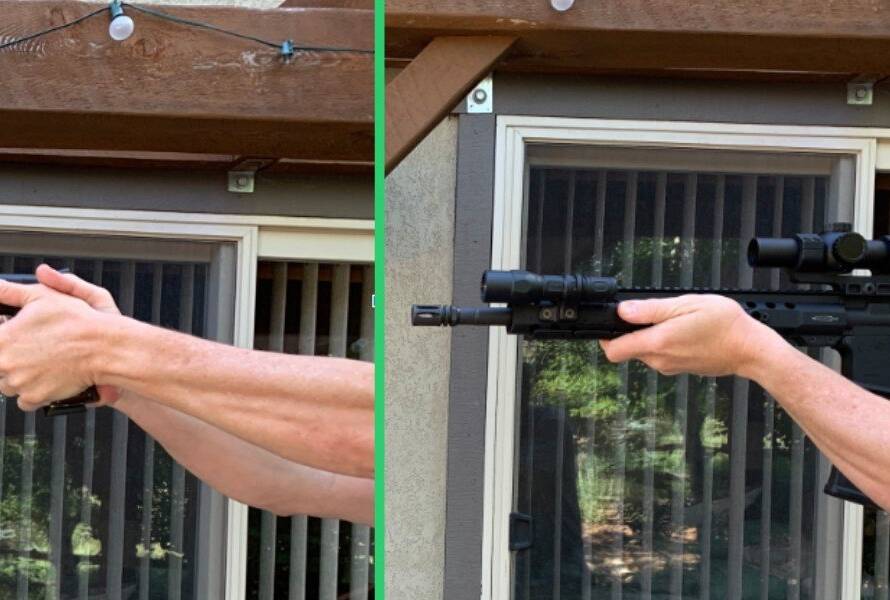
Walking into a gun store or browsing online for your first piece of glass can be sensory overload. You face a wall of numbers like “1-6×24” or “5-25×56,” jargon about “MOA vs. MRAD,” and price tags that sometimes exceed the rifle’s cost.
Without understanding the utility of optics and scopes, a new shooter might consider sticking to iron sights, which can put you at a significant disadvantage. The right firearm optics act as a force multiplier and help you shoot more accurately, identify targets clearly, and extend your firearm’s effective range.
If you’re setting up a home defense carbine or a precision bolt-action rifle, understanding fundamental scope options is the first step toward proficiency.
Firearm Optics Basics
Choosing the right firearm optics means matching magnification to your shooting distance. Beginners should distinguish red dots for close range, LPVOs for versatility, and high-power scopes for precision.
Here are a few key fundamentals to keep in mind:
- Match the Optic to the Mission: Red dots excel at 0–50 yards; magnified scopes are for 100+ yards.
- Glass Quality Over Features: High-quality lenses in a simple scope outperform poor glass in a “feature-rich” cheap scope.
- The “Used” Hack: You can often buy used optics from premium brands (like Vortex, Leupold, or Nightforce) for the same price as a brand-new budget brand.
- Mounting is Critical: Even the best scope is useless if it isn’t mounted with the correct torque and alignment.
Many shooters buy used optics from reputable sources to get professional-grade glass at entry-level prices without sacrificing quality. At RKB Armory, we help simplify the process of choosing quality optics for both new and experienced shooters.
Understanding the Primary Types of Firearm Optics
Before you buy, know which optic category fits your intended use. Generally, optics fall into three types: Non-magnified, Variable, and Fixed.
1. Red Dot & Reflex Sights
These are the most intuitive firearm optics. They project a simple illuminated dot onto a lens. You keep both eyes open, place the dot on the target, and pull the trigger.
- Best For: Home defense, competitive speed shooting, and target practice under 100 yards.
- Pros: Unlimited eye relief and extremely fast target acquisition.
2. Low Power Variable Optics (LPVO)
An LPVO looks like a traditional scope but starts at 1x magnification (no zoom). With a throw lever, you can increase it to 6x, 8x, or 10x.
- Best For: “General Purpose” rifles (like the AR-15) where you might need to shoot close-up or out to 400 yards.
- Pros: The “Swiss Army Knife” of scopes.
3. Long-Range & Precision Scopes
These are the high-magnification “telescopes” seen on bolt-action rifles. They often feature large “turrets” for adjusting windage and elevation.
- Best For: Long-range hunting and precision rimfire or centerfire competitions.
- Pros: Allows for extreme precision at distances exceeding 500 yards.
Anatomy of a Scope: Knowing the Terminology
Before buying your first scope, it’s important to understand some of the most common terms and features you’ll encounter:
- 3-9 (Magnification): The image can be zoomed from 3 times the naked-eye view to 9 times.
- x40 (Objective Lens): This is the diameter of the front lens in millimeters. A larger number (like 50 or 56) lets in more light, which is vital for hunting at dawn or dusk.
- Eye Relief: The distance between your eye and the lens. If you get too close to a high-recoil rifle scope, you risk a “scope eye” injury.
- The Reticle: This is the “crosshair.” Beginners should look for simple duplex or BDC (Bullet Drop Compensator) reticles before moving into complex “Christmas tree” grids.
Why You Should Buy Used Optics First
A common beginner mistake is buying a cheap new scope. In optics, you get what you pay for. A $150 new scope often has mushy adjustments and poor light transmission. Remember, clear glass beats more magnification.
The Value Proposition
Industry standards from groups like the NRA show that optical clarity and internal tracking of high-end scopes remain consistent for decades. This makes the secondary market robust. Buying used optics means the first owner pays the depreciation.
- Quality Assurance: High-end brands like Leupold and Vortex offer transferable lifetime warranties. If you buy a used one and it breaks, they still fix it.
- Better Resale: If you decide long-range shooting isn’t for you, a used Nightforce will hold its value much better than a brand-new “budget” brand.
Common Mounting Mistakes to Avoid
A $2,000 scope is only as good as the $100 rings holding it in place. Even high-quality optics can perform poorly if they are mounted incorrectly, which is why proper installation is just as important as choosing the right scope.
- Improper Torque: Over-tightening rings can crush the scope’s internal tube and ruin tracking.
- Eye Position: Mount the scope in your natural shooting position to ensure the “eye box” aligns perfectly.
- Leveling: If your crosshairs are tilted (canted), your shots will drift more to the side as distance increases.
Frequently Asked Questions
Q: Do I need a red dot or a scope for an AR-15?
A: If your primary goal is home defense or shooting under 100 yards, a red dot is superior. If you want to shoot at various distances, look into an LPVO.
Q: What is “Parallax” and should I worry about it?
A: Parallax is the apparent movement of the reticle against the target when you move your head. Most beginner scopes (under 9x) have a fixed parallax, so you don’t need to adjust anything. High-power scopes have a side knob to “focus” the image and remove this error.
Q: Is it safe to buy used optics?
A: Yes, provided you buy from a specialist. Sites like RKB Armory inspect for “ring marks,” lens scratches, and mechanical tracking to ensure the used optic performs like new.
Q: What is MOA?
A: It stands for Minute of Angle. It is a measurement of an angle that equates to roughly 1 inch at 100 yards. It’s how we measure accuracy and make adjustments on the scope, unless that scope uses a different system, which is called RMAD or Mil.
Starting Your Optical Journey at RKB Armory
The world of firearm optics is a rabbit hole, but you don’t have to dive deep on day one. Start by understanding your distance needs and prioritize glass quality over “cool” features you won’t use.
By choosing to buy used optics, you can afford the durability and clarity that professionals rely on without the professional price tag. Get behind some glass, spend time at the range, and let your equipment grow with your skills.
Ready to find your first high-quality scope?